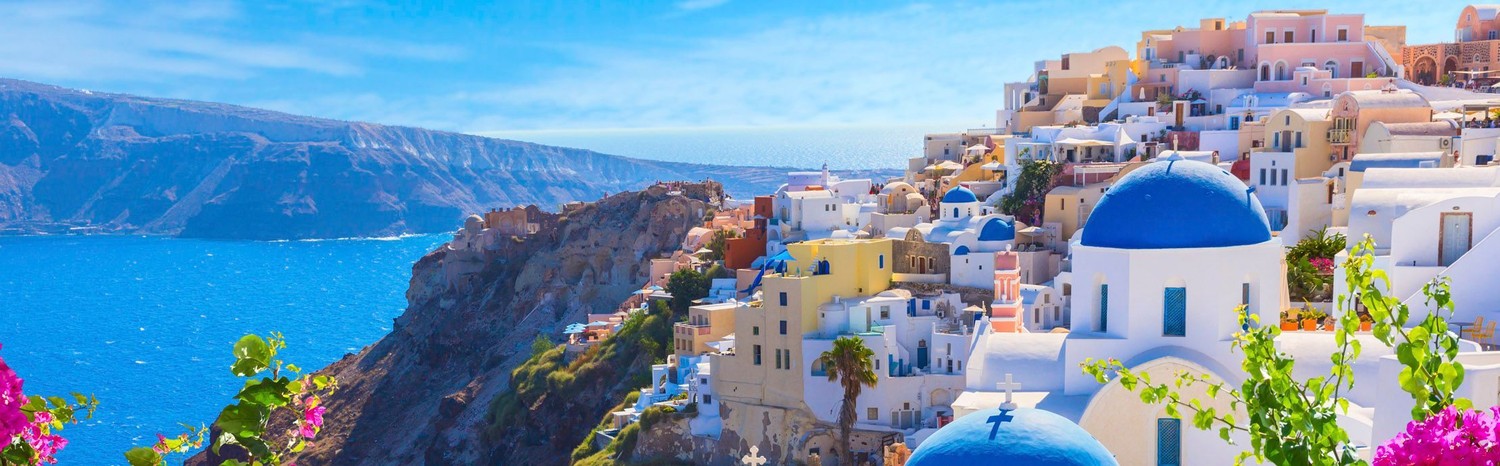
Greece Crewed Yacht Charters
Greece yacht charters let you explore one of the most diverse destinations in the Mediterranean.
The country has over 3,000 islands, connected by a network of ports and anchorages that make it easy for yachts to move from island to island.
Greece has five distinct cruising regions. The Cyclades host the country's most famous islands: Mykonos, Santorini, Paros, Naxos, and Milos.
The Ionian Islands are lush and calm, sheltered from the Meltemi winds that peak in the Cyclades during summer.
The Saronic Gulf is closest to Athens. The Dodecanese, along the Turkish coast, offer ancient history and Greece's sunniest skies.
Finally, the northern Sporades feature a national marine park and the country's quietest anchorages.
Why Charter a Yacht in Greece
Greece is a network of islands, but most of the ones worth visiting are small and reachable only by sea.
Ferries run limited or irregular schedules, which makes trips hard to plan, especially in winter. A private crewed yacht is the best way to see Greece properly.
With a yacht anchored offshore, guests can swim at the sea caves of Kleftiko in the Cyclades before the day-boats arrive.
They can wake off Fiskardo in the Ionian, or tender to a taverna on Hydra in the Saronic.
They can walk the medieval streets of Rhodes in the Dodecanese straight from the anchorage.
They can also cross into the National Marine Park of Alonissos in the Sporades, one of Europe's largest protected marine areas.
The Cyclades
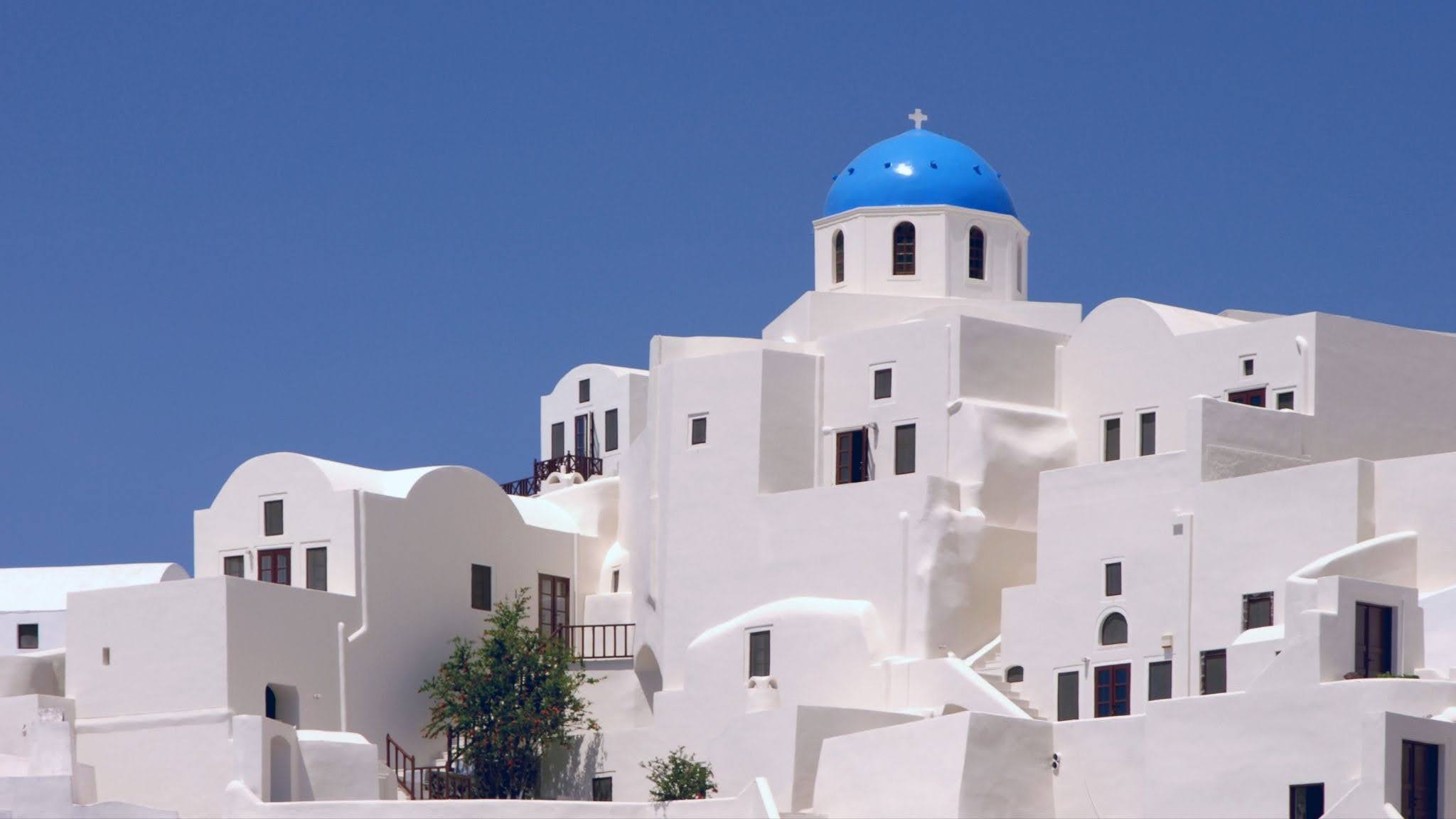
The Cyclades are the most visited group of islands in Greece’s five cruising regions. It is postcard Greece as everyone knows it: whitewashed villages, blue-domed churches, and clear Aegean water.
Mykonos
Mykonos is Greece’s most famous party island, with South coast beach clubs (Nammos, Scorpios, Principote) tendering guests directly from their yachts.
In town, Little Venice glows at sunset, where historic sea-captain houses overhang the water.
Northern beaches like Fokos and Agios Sostis suit a calmer pace.
Santorini
Santorini is famous for its whitewashed buildings, but few know its history.
A volcanic eruption around 1600 BCE collapsed the island center, creating a crescent cliff rising above the anchorage.
Towns like Oia and Fira sit atop the rim.
Ammoudi Bay, at the cliff’s base, connects to Oia via 300 rock-carved steps. Southward, Red and White Beaches feature unstable, undeveloped cliffs. Nearby, Akrotiri -the "Greek Pompeii" - remains preserved by ash from that same eruption.
Paros
Paros, a quieter alternative to Mykonos, is an ideal base for nearby islands. In northern Naoussa, fishing boats bring the daily catch into the village.
Nearby, Kolymbithres Beach features smooth granite formations, while Golden Beach offers soft sand and kite-surfing.
Across the channel, Antiparos provides a serene escape for swimming and beachside lunches.
Naxos
Naxos is the largest of the Cyclades and the most agriculturally self-sufficient.
Unlike Mykonos or Santorini, Naxos has fertile interior valleys, working farms, and mountain villages that predate the tourism industry.
Its most recognizable landmark is the Portara: a massive marble doorway on an islet connected to the main town, all that remains of a 6th-century BC temple to Apollo.
Long sandy beaches like Agios Prokopios, Plaka, and Agia Anna stretch for miles on the southwest coast.
Inland villages like Halki and Apeiranthos produce local cheeses (graviera and arseniko) and citron liqueur you won't find anywhere else in Greece.
Milos
Milos has over 70 beaches, more than any other island in the group. Sarakiniko, in the north, is sculpted into white cliffs and inlets reminiscent of the moon's surface.
Kleftiko, on the southwestern side, offers sea caves and towering cliffs with turquoise waters ideal for snorkeling.
In the west, the fishing village of Klima features 'syrmata', or brightly painted boat garages built directly into the cliff.
It is also the island’s historical claim to fame; a farmer unearthed the Venus de Milo statue here in 1820.
Milos stands apart from the Cyclades with its dramatic volcanic landscapes, unlike the classic rocky terrain of its neighbors.
The Ionian Islands
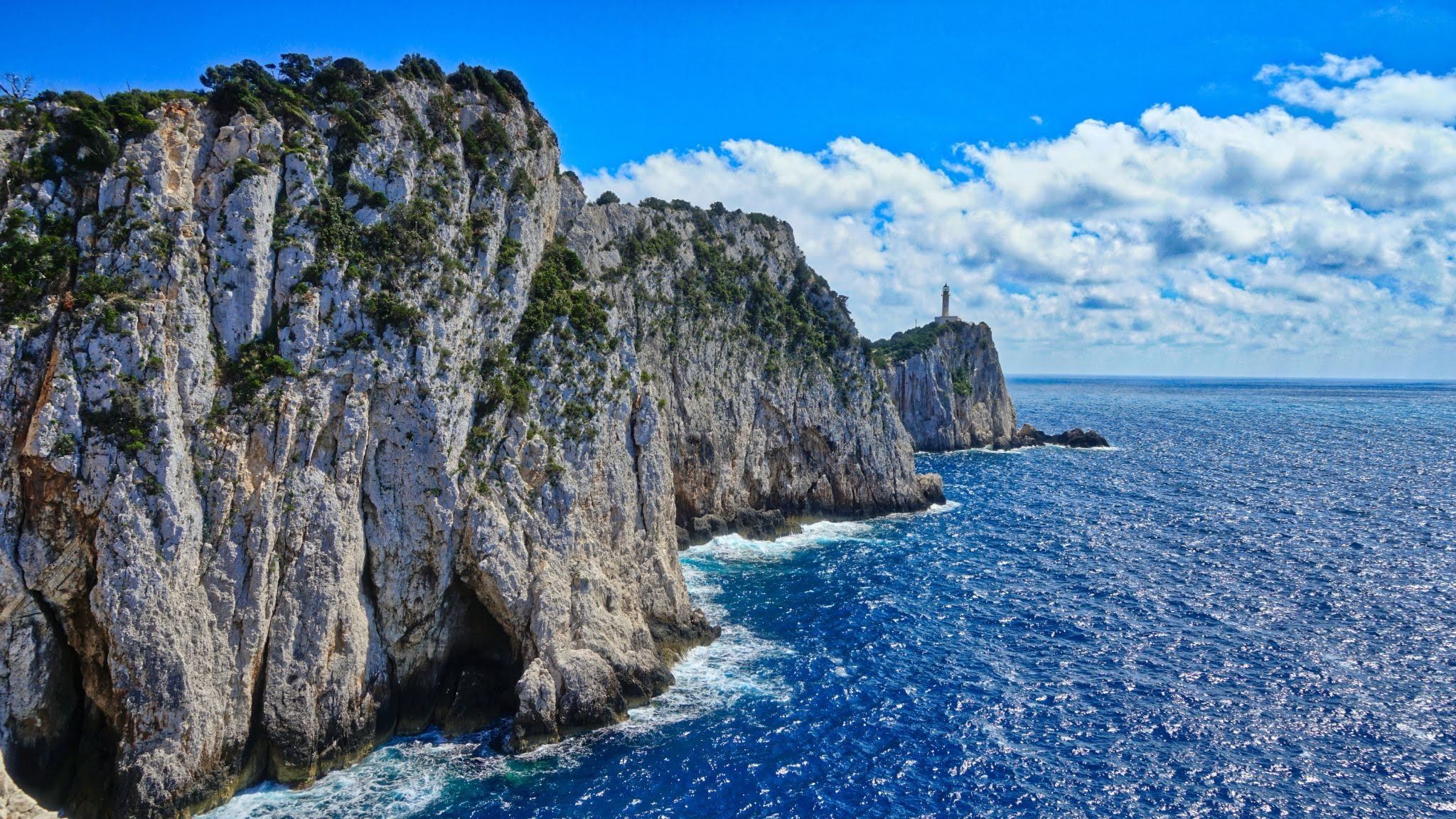
The Ionian Islands are on the west coast of Greece. They are closer to Italy than to Athens, and they look and feel different from the Aegean.
The landscape is green and wooded, and the water stays calm through summer because the Meltemi wind belt doesn't reach this side of Greece.
Corfu
Corfu is the largest and most cosmopolitan of the Ionian Islands, and the main base for charters starting in the region.
Corfu Town, on the island’s eastern shore, is a UNESCO World Heritage site.
Two Venetian fortresses guard the old town. The narrow streets between them are lined with pastel-colored buildings, arcades, and small squares from 400 years of Venetian rule.
Outside town, Paleokastritsa, on the western shore, has six small coves under wooded cliffs, with clear water and a hilltop monastery above the anchorage.
The northeast, from Kassiopi down to Kalami, stays quieter than the southern resorts and has some of the best swimming anchorages on the island.
Paxos
Paxos is a small island south of Corfu. It is about 10 by 4 kilometers, and one of the quietest anchorages in the Ionian.
It has three main harbors: Gaios, the capital, with pastel Venetian houses along a narrow channel; Lakka, a horseshoe bay in the north known for its swimming; and Loggos, the smallest and most photographed. All three are within a short cruise of each other.
Across a narrow channel to the south, Antipaxos has fewer than 100 residents and two beaches, Voutoumi and Vrika, reachable only by boat. Antipaxos is famous for its tropical jade water.
Kefalonia
Kefalonia is the largest of the Ionian Islands and the most geologically dramatic.
Myrtos Beach, in the northwest, is a long crescent of white pebbles below a nearly vertical 300-meter cliff, one of the most striking beaches in the Ionian.
Fiskardo, on the northern tip, is the only village that survived the 1953 earthquake.
Most of its pastel Venetian houses are original 18th- and 19th-century buildings rather than reconstructions. It's the most requested anchorage on Kefalonia, with fish tavernas lining the waterfront.
The nearby Melissani Cave is an underground lake with an open ceiling. When the sun is directly overhead, the water turns bright blue.
Zakynthos
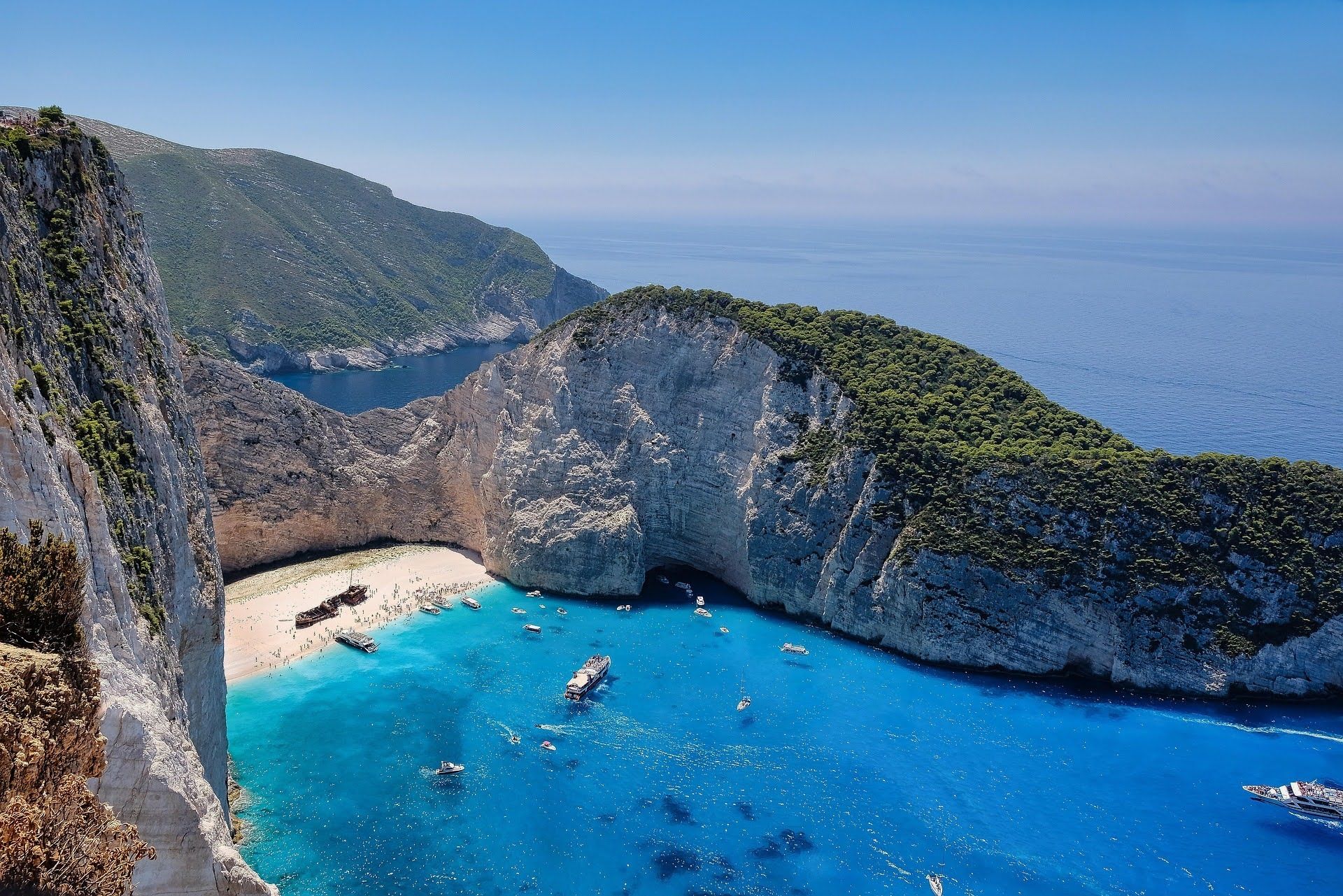
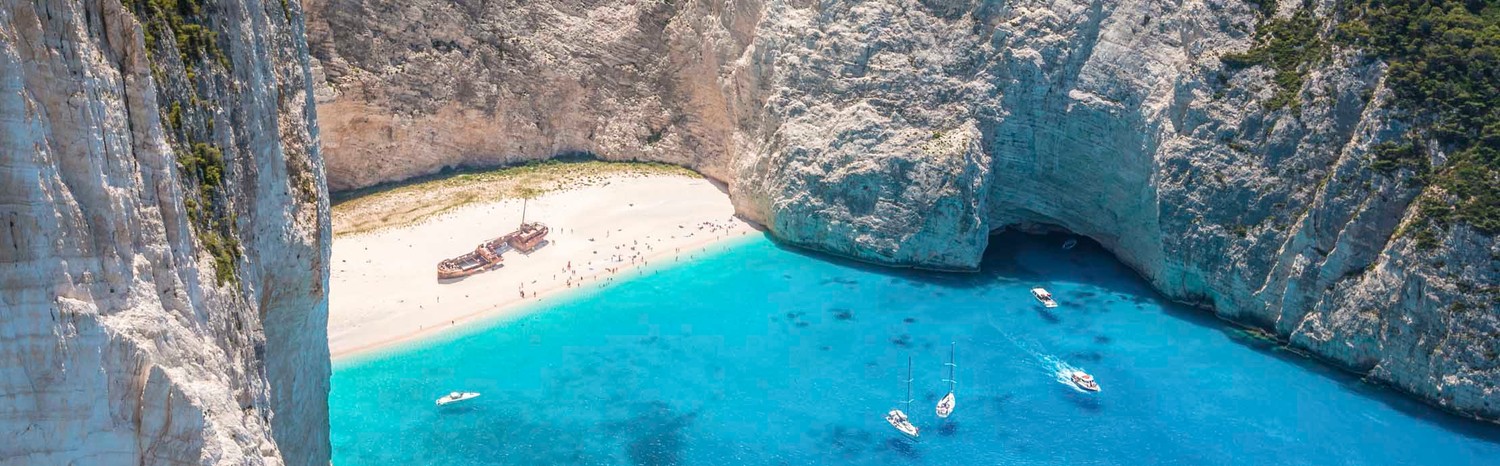
Zakynthos is best known for Navagio Beach in the northwest: a crescent of white sand at the base of towering limestone cliffs, reachable only by boat. It's also called Shipwreck Beach for the rusted 1980 freighter half-buried in the sand.
It's the most photographed beach in Greece and crowded with day boats midday, so visit early morning or late afternoon.
The Blue Caves nearby are sea arches and grottos where light reflects off the white limestone underwater and turns everything blue.
Farther south, Marathonisi Island in Laganas Bay is a nesting site for loggerhead sea turtles, protected by the Zakynthos National Marine Park.
Lefkada
Lefkada has some of the most dramatic beaches in Greece on its western shore, and one of the most popular island-hopping loops in the Ionian on its eastern side.
Porto Katsiki, Egremni, and Kathisma are all long stretches of white sand at the base of tall white cliffs.
The eastern shore is sheltered from the open sea and dotted with small islands: Meganisi, Kalamos, and Kastos. Skorpios, one of the small islands, was owned by Aristotle Onassis from 1962 until his death.
The Saronic Islands
The Saronic Islands are the closest cruising region to Athens, and the easiest starting point for a first Greek charter.
The islands are grouped between Athens and the Peloponnese coast and have short passages between them.
The water is calm year-round because the Saronic Gulf is sheltered from the open Aegean.
Hydra
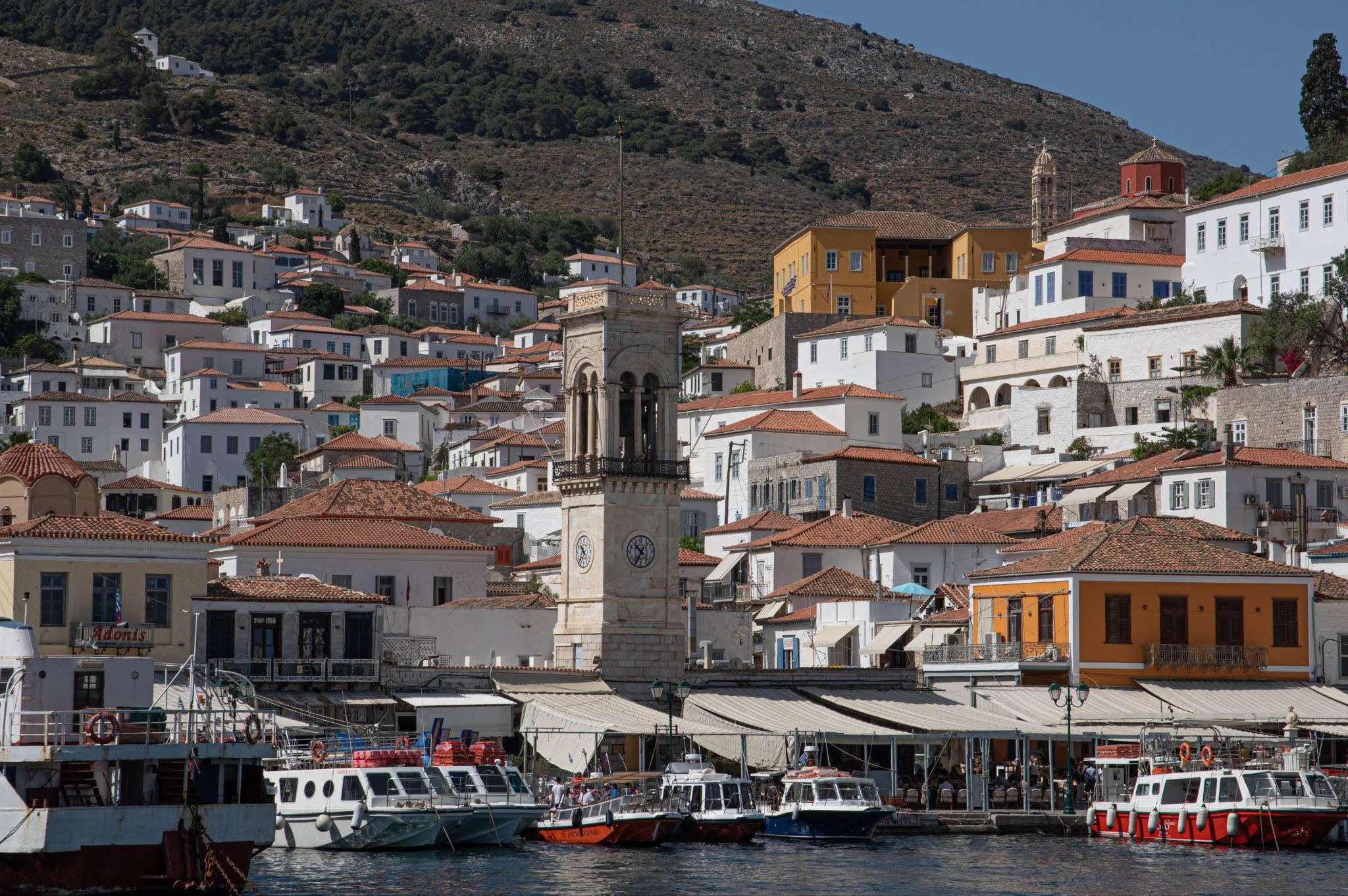
Hydra is the most famous of the Saronic Islands and one of the most protected historic settlements in Greece.
Cars, motorcycles, and even bicycles are banned across the entire island.
Donkeys and porters handle deliveries between the harbor and the houses in the hills above.
The harbor is a natural amphitheater. Wealthy shipowners built the 18th- and 19th-century stone mansions during the island's peak as a naval power, and many are now small museums.
The island also has a strong contemporary art scene, with galleries and exhibitions that draw collectors from the mainland.
Spetses
Spetses is greener and more forested than the other Saronic Islands, with pine trees stretching down to the water.
Like Hydra, cars are restricted inside the main town, but horse-drawn carriages and motorcycles are allowed on the rest of the island.
Neoclassical mansions from the 19th century line the Old Harbor at Dapia, when Spetses was one of Greece's wealthiest shipping islands.
The Bouboulina Museum, in the former home of naval heroine Laskarina Bouboulina, tells the island's role in the 1821 War of Independence.
Poros
Poros is separated from the Peloponnese by a narrow channel, about 200 meters wide at the crossing point.
Cruising into the harbor feels closer to entering a Venetian canal than an open bay.
The town spreads across a low hill above the waterfront, topped with a clock tower that's the island's landmark.
The pine-covered interior stretches to small coves in the south. The mainland side of the channel holds the ancient Sanctuary of Poseidon, a 20-minute walk from the harbor.
Lemon groves cover the plain across the channel, and lemon liqueur is the local specialty.
Aegina
Aegina is the closest Saronic island to Athens, about 90 minutes by sea, and one of the earliest inhabited islands in Greece.
The main town has a working fishing harbor at its center, and boats sell the morning catch directly from the quay.
Aegina is the pistachio capital of Greece: the island's tree-grown Fistiki Aeginis has European protected status, and the pistachio harvest festival in September brings visitors from Athens and across the mainland.
The island is also home to the Temple of Aphaia, built around 500 BCE and one of the best-preserved Doric temples anywhere.
The Dodecanese
The Dodecanese islands are the easternmost of Greece's cruising regions, a chain along the Turkish coast that includes some of the sunniest islands in the country.
The region passed through Ottoman, Italian, and finally Greek control over the last 500 years, and the architecture in the main towns reflects all three.
Rhodes
Rhodes is the largest of the Dodecanese and one of the most historically layered cities in the eastern Mediterranean.
The Old Town of Rhodes City is a UNESCO World Heritage site. The Knights of St. John built the medieval walled city in the 14th century.
Cobblestone streets, stone gates, and the Palace of the Grand Master still stand at its center. The Colossus of Rhodes once stood at the entrance to Mandraki Harbor.
It was one of the Seven Wonders of the Ancient World until an earthquake destroyed it in 226 BCE.
South of the city, Lindos is a whitewashed village below a hilltop acropolis, with the Temple of Athena Lindia above St. Paul's Bay and a long crescent beach below.
Kos
Kos is the second-largest of the Dodecanese. It's the birthplace of Hippocrates, the ancient Greek physician often called the father of medicine.
In the 4th century BCE, students of Hippocratic medicine trained and treated patients at the Asklepion, an ancient healing sanctuary about four kilometers from Kos Town.
Kos Town has Hellenistic ruins, medieval walls, Ottoman mosques, and Italian colonial buildings. Each style reflects a different era of foreign rule.
The island is a common starting point for charters heading north toward Patmos or south toward Rhodes and Symi.
Symi
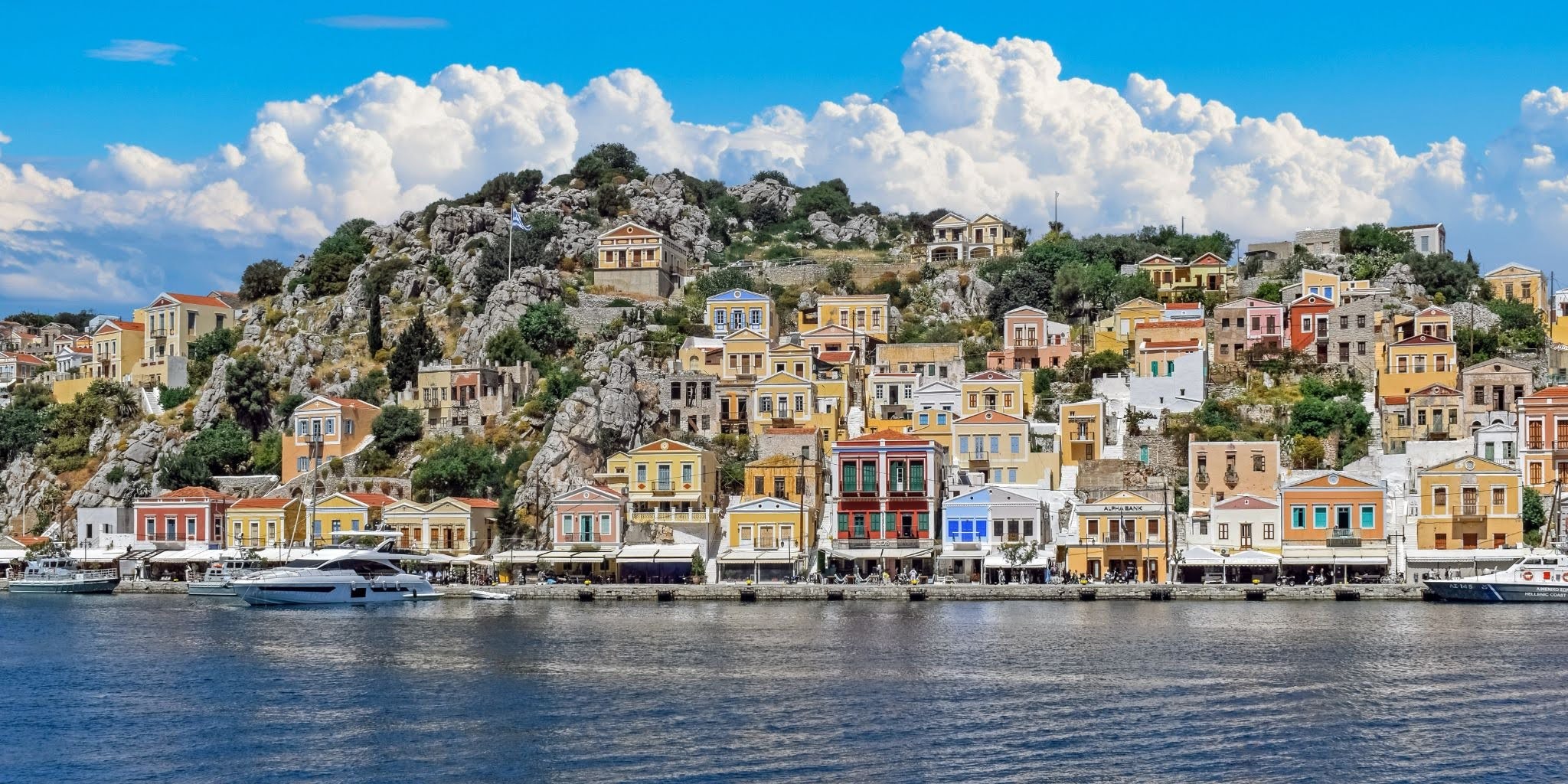
Symi has one of the most photographed harbors in Greece. Neoclassical mansions in pastel yellows, ochres, and pinks rise from both sides of a narrow inlet, built during the island's peak as a sponge-diving center in the 19th century.
The Monastery of the Archangel Michael Panormitis, in the south, is dedicated to sailors. It's one of the most important pilgrimage sites in the Dodecanese.
Guests can anchor in the bay in front of it and visit the small maritime museum of votive offerings left by Greek sailors over the centuries.
Symi is also known for the small pink shrimp caught in the surrounding waters, sold at the tavernas the same night they're brought in.
Patmos
Patmos is best known as the island where St. John the Apostle wrote the Book of Revelation, in a cave above the port town of Skala.
The Cave of the Apocalypse and the 11th-century Monastery of St. John form a UNESCO World Heritage site.
Together they are among the most important Christian pilgrimage destinations in the Aegean.
The Sporades
The Sporades are the least developed of Greece's five cruising regions. The islands are located in the northern Aegean off the coast of Thessaly.
The National Marine Park of Alonissos, one of the largest protected marine areas in Europe, covers most of the region.
Skiathos
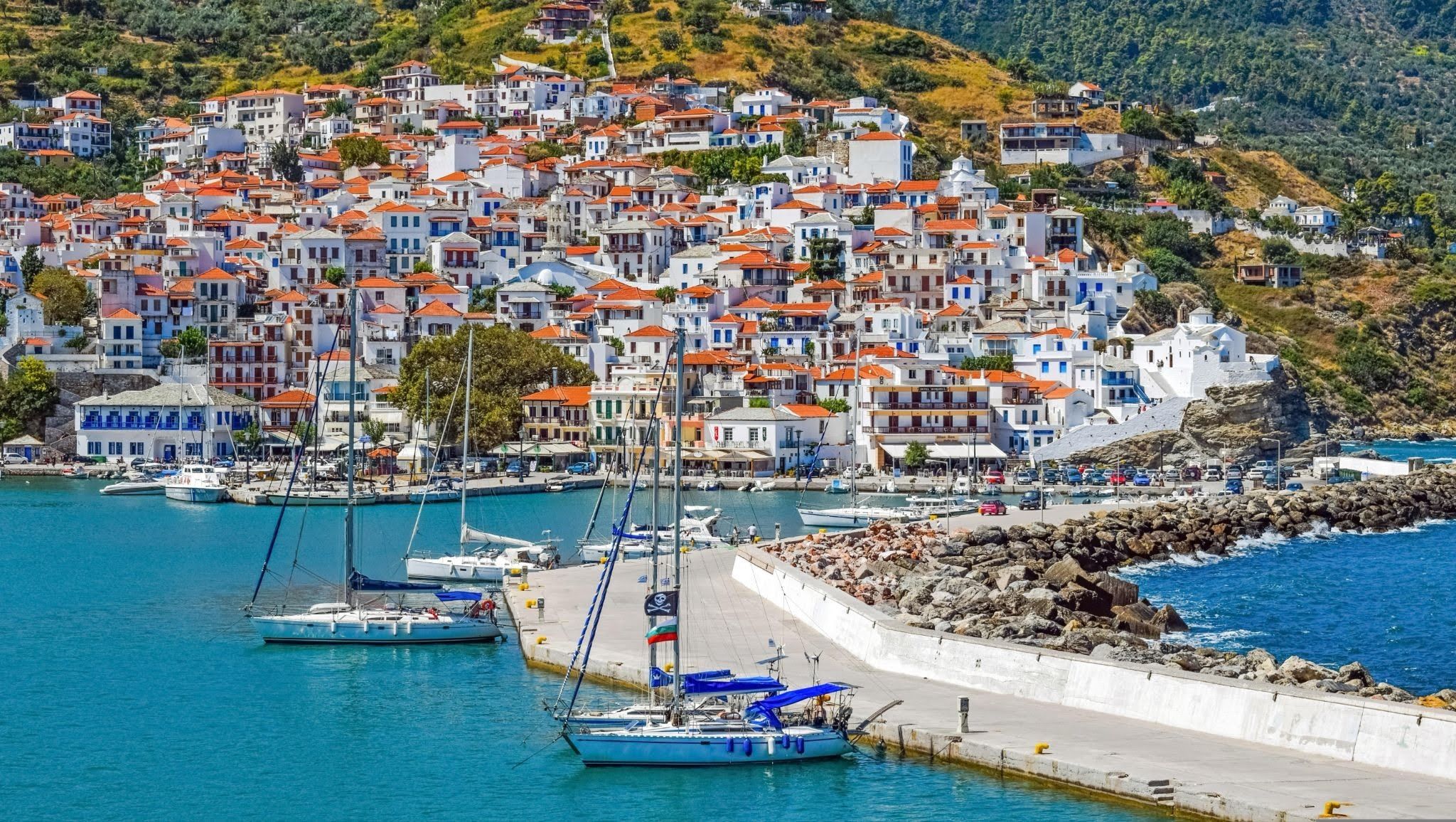
Skiathos is the most visited of the Sporades and the entry point to the region: it has an international airport and a small port town in the southeast.
The town is built along the harbor, with red-tiled houses climbing the hill above and cafes and tavernas along the waterfront.
The island is famous for its beaches, particularly Koukounaries in the south. It's named for the pine forest along the strip (koukounaria means pine cone in Greek).
Lalaria, on the northern tip, is only reachable by boat: smooth white pebbles under white marble cliffs, with a natural stone arch at the water's edge.
Skopelos
Skopelos is the greenest area of the Sporades, with pine forest covering more than half the island down to the shoreline. There are almost no beach resorts or large hotels here.
Most of the coast is undeveloped. Guests reach the swimming coves by boat or by walking from the villages.
Skopelos’ main town is built up the side of a hill in the classic Aegean style, with whitewashed houses and blue shutters stacked in tiers above the harbor.
The island became internationally recognizable in 2008 as the filming location for the movie Mamma Mia!, though it’s quieter and more traditional than the film suggests.
Alonissos
Alonissos is the outer edge of the region and the least developed of the Sporades. The National Marine Park that surrounds it protects one of the last populations of the Mediterranean monk seal, one of the world's rarest marine mammals.
Only the southern part of the island is inhabited, with the old capital, Palaia Alonissos, on a hilltop above the modern port of Patitiri.
The northern half is uninhabited pine forest. Guests reach the smaller islets inside the marine park, including Peristera and Kyra Panagia, by tender.
Choosing Your Greece Yacht Charter
Guests planning a Greece yacht charter should consider which region they want to visit, as it determines the type of yacht they should book.
For example, a motor yacht that suits the Cyclades may not be the right fit for the Saronic loop.
Motor yachts can accommodate 6 to 12 passengers and are the fastest option for journeys that cover more ground, such as in the Cyclades.
They handle open-water crossings like the Athens-to-Mykonos passage well. Most Greek superyachts fall into this category and charter on a plus-expenses basis.
Sailing yachts can accommodate 4 to 10 guests. They suit couples, small groups, and guests who want the experience of sailing on a traditional boat. Their smaller frame slips into narrow harbors and coves that larger yachts can't reach, and they run quieter than motor yachts.
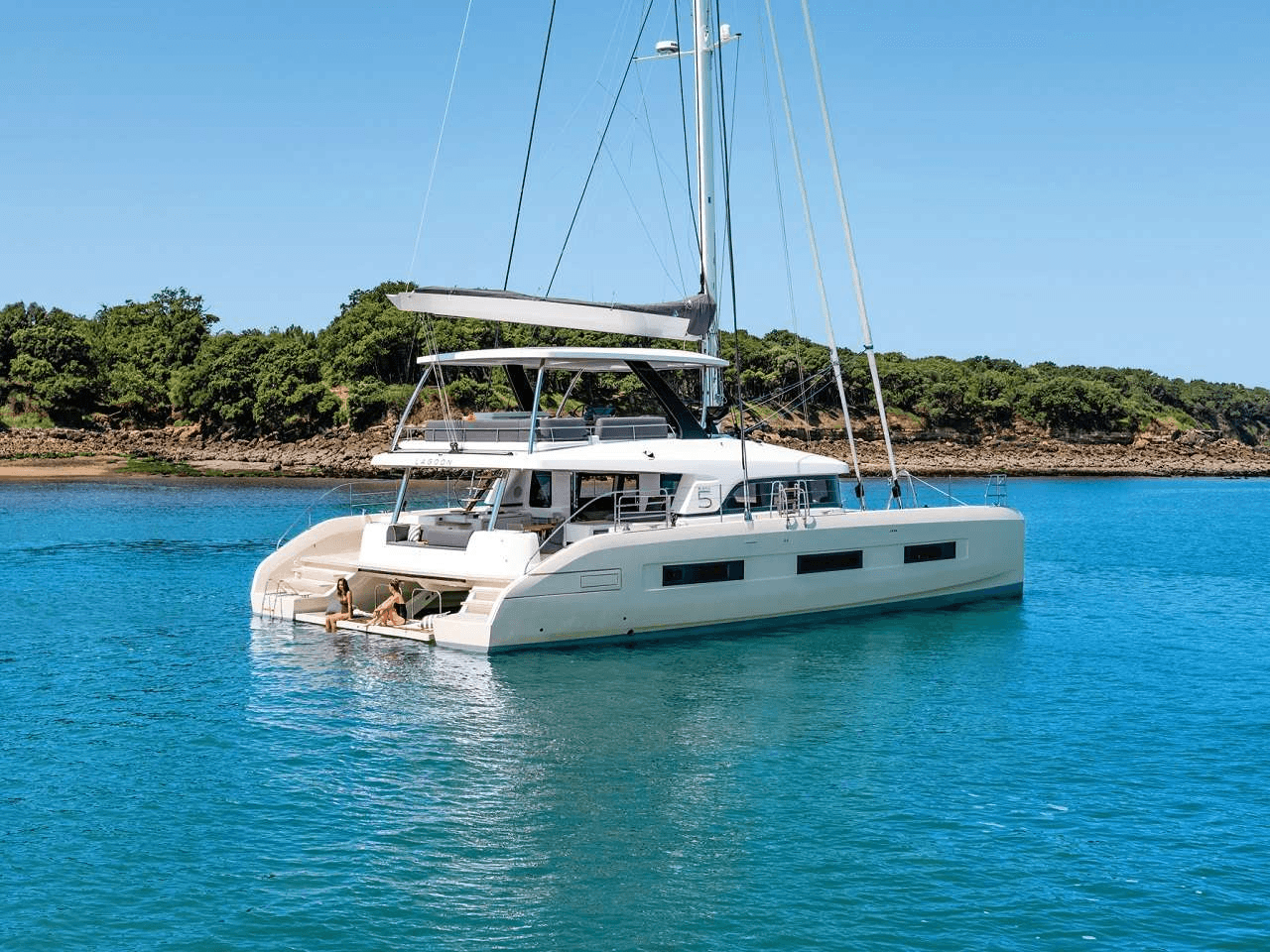
Catamarans hold 6 to 12 guests and are the most popular choice for families and mixed-age groups. Two hulls keep the boat flat and steady, with more deck space than a single-hull yacht.
The design also lets the boat float higher in the water, so catamarans reach smaller bays and coves that single-hull yachts can't. They're common across the Saronic and Ionian, and increasingly used in the Cyclades.
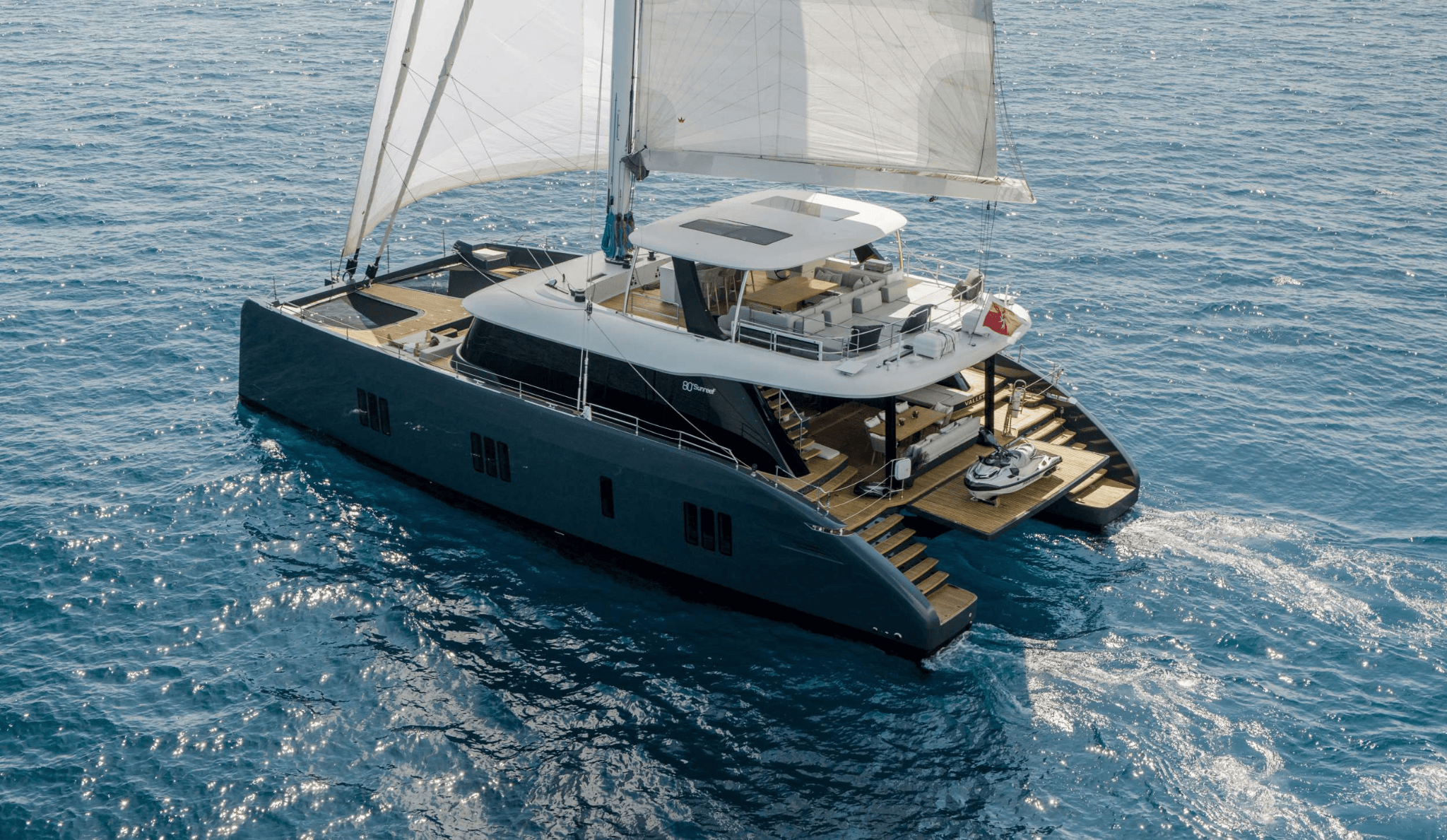
Motor sailers and superyachts can hold 8 or more guests and can combine full luxury service with the range to cover multiple cruising regions in one charter. Both operate on a plus-expenses basis.
Gulets hold 16 to 20 guests and are the largest option for a single group. Common across Greece, Croatia, and Turkey, these traditional wooden sailing vessels have broad decks and large shared spaces built for socializing.
They suit big families, multi-couple trips, and celebrations that need room for everyone on one boat.
Ritzy Yachts has an extensive charter fleet. A charter broker can assist you in finding the best luxury yacht for your journey.
Which Greek region suits you?
If you want… | Best region | Notes |
Iconic islands and nightlife (Mykonos, Santorini) | The Cyclades | Windier in peak summer because of the Meltemi Best for a motor or sailing yacht |
Calm water, green landscapes, easy first charter | The Ionian | Sheltered from the Meltemi; Ideal for families and first-timers |
Short cruising legs, culture, somewhere close to Athens | The Saronic | The easiest Athens-based week; Great for catamarans |
History, forts, somewhere off the beaten path | The Dodecanese | Located on the eastern Aegean along the Turkish coast; the sunniest region |
Nature, pine forests, a marine park | The Sporades | Quiet and green; great for divers and nature lovers |
What is Included in a Greece Yacht Charter
Most private charter yachts in the Mediterranean, including Greece, operate on a plus-expenses basis.
The base rate covers the yacht and the crew’s services. Operating costs come from a separate Advance Provisioning Allowance (APA), which the captain collects on top of the charter rate.
The APA is typically 20 to 25 percent of the base charter fee for sailing yachts, and 30 to 35 percent for motor yachts. It covers fuel, provisioning, dockage, and other onboard expenses during the week.
At the end of the charter, the captain provides a detailed account of the APA expenses, and any unused funds are returned.
Crew gratuity is separate and remains at your discretion. In the Mediterranean, it is customary at 10 to 15 percent of the base charter rate.
Yachts can also follow an all-inclusive pricing model, which covers the yacht, a professional crew, all meals, a standard ship's bar, and the onboard water toys.
Your only added costs are onshore excursions, meals ashore, and airport transfers. But these are more common in Caribbean charters.
How to Book a Greek Yacht Charter
Ritzy Yachts arranges crewed Greek charters through a single point of contact. The process is straightforward:
Share your vision. Tell us about your ideal charter, including your preferred destination, travel dates, group size, and the type of experience you're looking for.
Review your curated options. Based on your requirements, we'll present a tailored selection of yachts and destinations, along with expert recommendations from our charter team.
Select your yacht. Once you've found the right fit, we'll guide you through the charter agreement and place the yacht on hold while arrangements are finalized.
Confirm your charter. Your charter is secured upon signing the agreement and submitting the initial deposit.
Personalize every detail. Before departure, we'll coordinate your preferences, including dining requests, beverages, activities, special occasions, and itinerary considerations to ensure a seamless onboard experience.
The minimum charter length in Greece is one week. Peak weeks are in July and August. If you’re eyeing these dates, book as early as possible.
Sample Greek Itineraries
Ritzy Yachts publishes six standard Greek itineraries, each customizable to the group's preferences
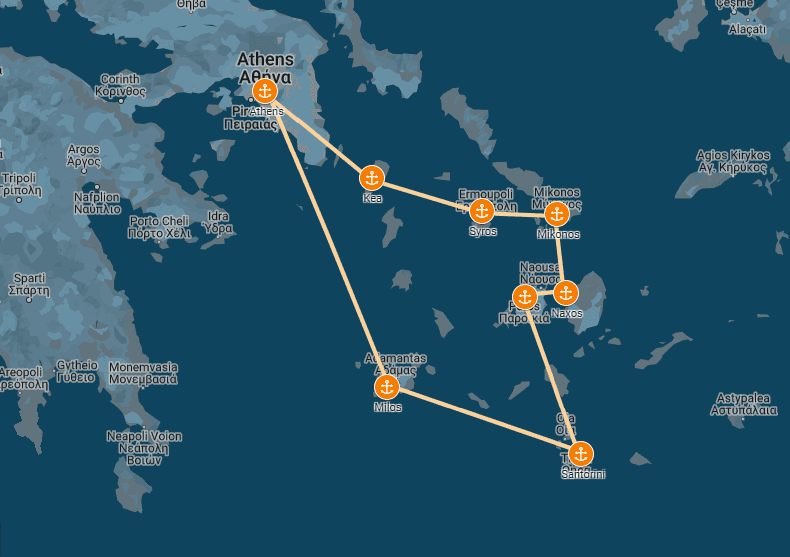
Northern Cyclades: 7 nights, 204 nautical miles
Southern Cyclades: 7 nights, 313 nautical miles
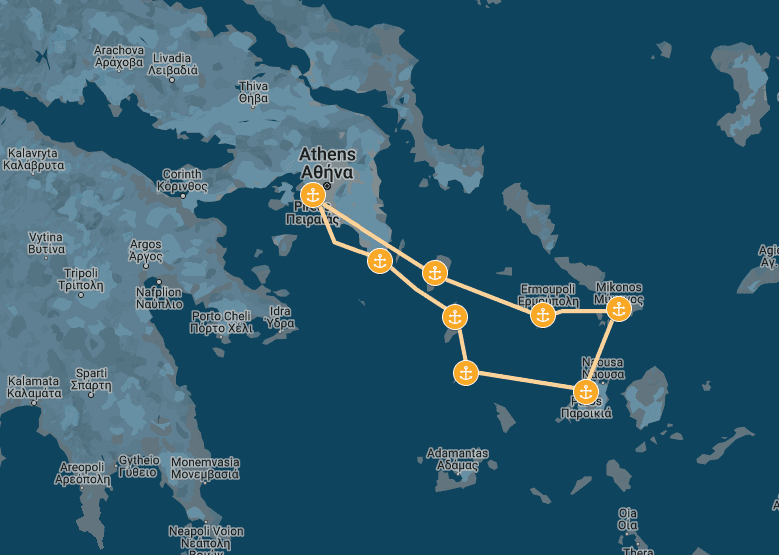
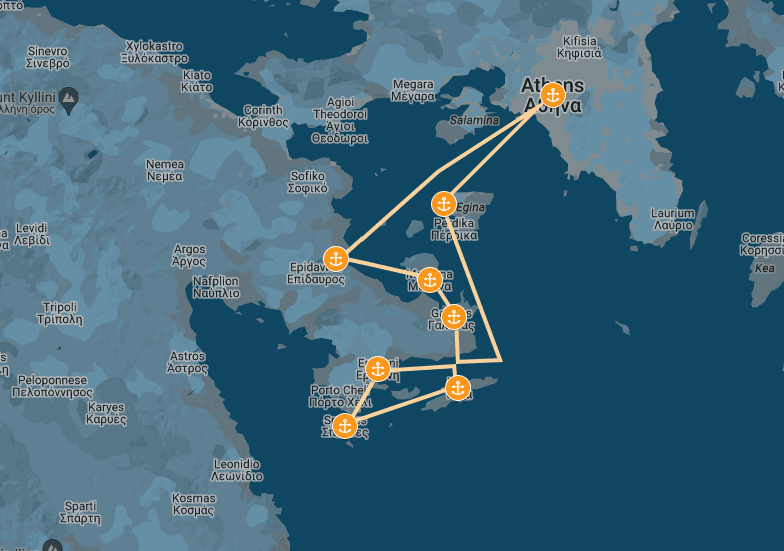
Saronic Gulf: 7 nights, 142 nautical miles
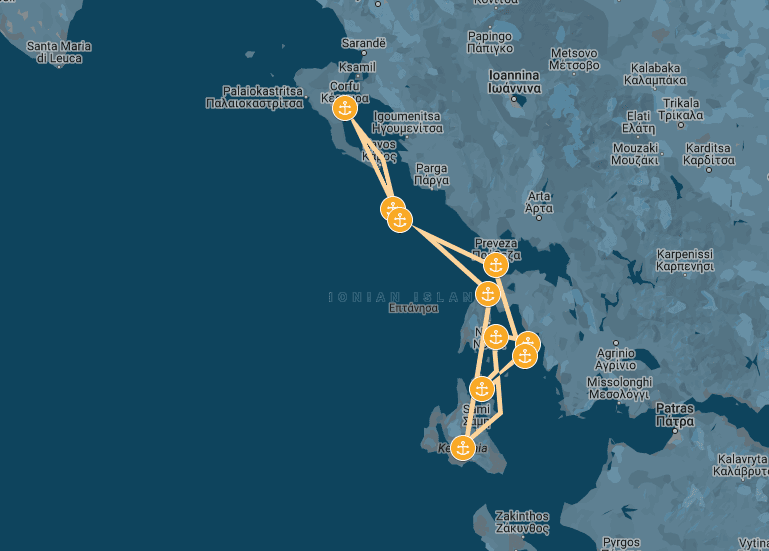
Ionian Islands: 7 nights, 234 nautical miles
Northern Ionians: 6 nights, 87 nautical miles
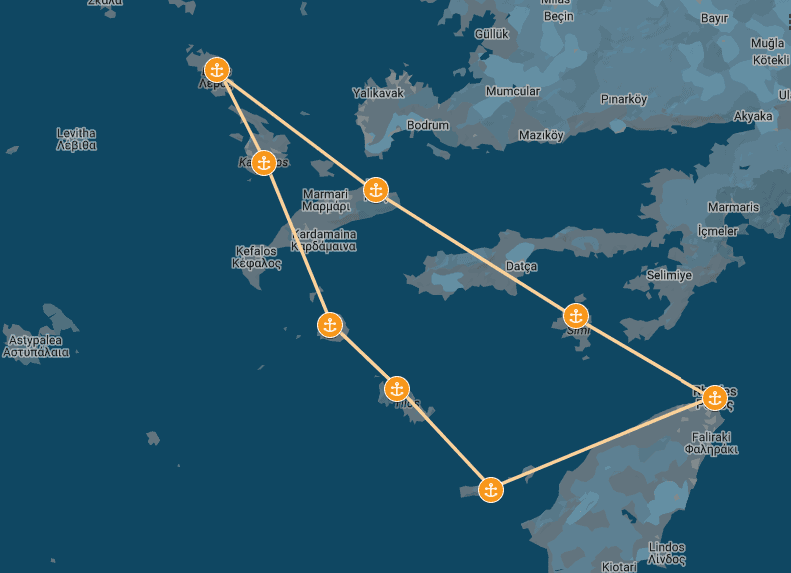
Dodecanese: 7 nights, 239 nautical miles
For a fully custom route, contact our charter brokers to build itineraries around specific islands, family activities, or events like the Aegean Regatta.
How to Get to Greece
Most Greek charters start in Athens, from one of three marinas:
Alimos Marina, the largest marina in Greece and the most common charter base, about 15 minutes from Athens International Airport.
Flisvos Marina, closer to central Athens and the primary base for superyachts.
Lavrion, on the southeastern tip of Attica, about 45 minutes from the airport and the easiest departure point for the Cyclades.
For Ionian charters, guests fly into Corfu (Gouvia Marina) or Preveza (near Lefkada). For Dodecanese charters, Kos and Rhodes both have international airports and function as regional charter bases.
Best Time and Sailing Conditions in Greece
The Greek charter season runs from June to September. June, July, and August are the peak months, with the warmest weather and most demand, so book these dates early.
September is a quieter alternative: still warm and calm, but with fewer boats on the water. October charters are possible but limited, as the season winds down.
July and August are also when the Meltemi winds are strongest.
The Meltemi is a strong, dry northerly wind that blows down through the Aegean from mid-July through August. It affects the Cyclades and the Dodecanese most.
On the strongest days, it can reach 25 to 35 knots and reshape the day’s route.
The Ionian and the Saronic are both sheltered geographically, so the Meltemi rarely reaches the same intensity in those regions.
Every crewed charter operates with a professional captain who monitors forecasts, plans routes, and adjusts anchorages daily to avoid exposed bays and open crossings on the windiest days. Guests do not need any sailing experience or license.
Ready to Charter a Yacht in Greece? Plan It with Ritzy Yachts
Ritzy Yachts brokers help match you with the right yacht and crew for your Greek charter.
Discover the best of the Greek islands: speak with one of our brokers to start the proposal.
Choose your luxury Yacht Charter
- All yachts
- Motor Yachts
- Catamarans/Tri
- Monohulls
- Motor Sailers
- All prices
- $9,000 - $15,000
- $15,000 - $20,000
- $20,000 - $25,000
- $25,000 - $30,000
- $30,000 - $50,000
- $50,000 - $70,000
- $70,000 - $100,000
- More than $100,000
- All sizes
- Less than 45'
- 45' - 50'
- 50' - 55'
- 55' - 65'
- 65' - 80'
- 80' - 100'
- 100' - 115'
- 115' - 130'
- 130' - 150'
- More than 150'
 Scuba
Scuba- Default
- Yacht Name: A-Z ↑
- Yacht Name: Z-A ↓
- Price: Low to High ↑
- Price: High to Low ↓
- Size: Smallest First ↑
- Size: Biggest First ↓
- Year Built: Newer First ↑
- Year Built: Classics First ↓
- Number of Guests: Asc ↑
- Number of Guests: Desc ↓
- USD


CARTOUCHE
Yacht Charter Fee in Base Currency: USD
$0 - $0
per WeekSleeps 8 guests in 4 Cabins
Size: 95 Ft


- ‹
- 1
- 2
- 3
- 4
- 5
- 6
- 7
- 8
- 9
- ›
Last exchange rates update:
Top features


General information

Best time to charter:
Peak Season: June to August.
Mid Season: May, September & October.
Low Season: November to April.

Closest Airports:
Eleftherios Venizelos International Airport, Athens.
Santorini (Thira) International Airport.
Mykonos International Airport.
Ioannis Kapodistrias International Airport, Corfu.
Rhodes-Diagoras International Airport.

Climate:
The Cyclades and Aegean islands experience the Meltemi winds in July and August. Charters in the Aegean are less likely to be affected by them in May and June and September and October. Charters in the Saronic islands, the Ionian islands and southern Peloponnese are more sheltered from the Meltemi.

Timezone:
Eastern European Time (GMT/UTC +3 hours)
Additional information
Language: Greek & English – Currency: Euro – Religion: Christian
Learn more about Greece
Greece has 9,000 miles of coastline and over 2,000 islands, just 170 of which are inhabited. There is no better way to see the Greek Islands and the coast of mainland Greece than on your own private yacht.
The majestic isles of the Cyclades, Dodecanese, Sporades, and Ionians provide a picturesque and historic backdrop for a Greek sailing trip. Regardless of where your Greece charter begins, each area provides a distinct vantage point from which to enjoy the islands in tranquilly or in resort towns filled with white-sand beaches, sophisticated cuisine, and fashionable stores.
Open-water crossings or voyages in tranquil gulfs and bays are options for Greece yacht charters, as is the opportunity to explore fascinating ancient ruins. When it comes to chartering in Greece, it all comes down to personal preference.
Several of the islands have airports and quick helicopter access, making meeting your yacht a breeze. You may travel between the islands to visit hidden beaches, learn about each island's distinct local culture, and sample new food and goods every day.
Greece Charter Itineraries
Please be aware that the final itinerary will be determined on board in consultation with the Captain, contingent upon weather conditions and other external factors at the time of the voyage.

Sailing Yachts:
7 - 10 knots cruising speed.
Cruising Yachts:
10 - 14 knots cruising speed.
High-Speed Yachts:
20+ knots cruising speed.
Yacht Charter Pricing
All Inclusive
Typically this includes all your breakfasts, lunches, dinners and snacks. Standard Ship's Bar which includes your alcoholic and non alcoholic beverages. Fuel for the yacht and its tender, and the necessary water for the onboard facilities. Use of the Yacht’s onboard equipment and the Captain, Chef and Crew’s services.
Excluded are airport transfers costs, onshore excursions and tours, as well as any food or beverages purchased ashore. Although optional, crew gratuity is customary at 15% - 20% of the charter rate for the Caribbean and 10% - 15% for the Mediterranean.
Plus Expenses
Included are the Yacht and its onboard equipment as well as the Captain, Chef and Crew’s services.
Excluded are food and beverages, fuel for the yacht and its tender, any dockage, airport transfers costs, onshore excursions and tours, as well as any cruising permits, licenses and other charter related expenses. Crew gratuity, although optional is customary at 15% - 20% of the charter rate for the Caribbean and 10% - 15% for the Mediterranean.
Advanced Provisioning Allowance:
Types of Vessels

Catamaran Yacht Charter
Catamarans are the most popular choice for Caribbean charters. Their twin-hull design provides exceptional stability, making them ideal for families. With spacious deck areas, generous cabins, and a shallow draft for accessing secluded bays, a catamaran offers unmatched comfort on the water.

Motor Yachts
For those who value speed and opulence, motor yachts deliver an unparalleled experience. These vessels cover longer distances quickly, allowing you to explore more of the Caribbean in less time. Expect world-class amenities — from sun decks and jacuzzis to gourmet galleys and state-of-the-art entertainment systems — all wrapped in sleek, head-turning design.

Motor Sailers
Motor sailers blend the romance of wind-powered sailing with the reliability of engine-driven cruising. These versatile vessels let you hoist the sails when the breeze is right and switch to motor power when conditions demand it. Perfect for couples and adventurers seeking a more intimate, authentic seafaring experience without sacrificing modern comforts.
Top Yacht Charter Destinations

Greece

Croatia

Amalfi Coast

Turkey

Balearic Islands

Sicily

Corsica

Sardinia

French Riviera Yacht Charters
Italian Riviera Yacht Charters
Greece
Top features


Greece is one of the world's most popular yachting destinations. The Cyclades, Ionian, and Saronic Island groups each have their own unique charms, drawing charter guests to return for new experiences. Read on to explore each of these areas.


Amalfi Coast
Top features


The Amalfi Coast, widely regarded as Italy's most picturesque coastline, attracts the most affluent visitors due to its breathtaking scenery of cobblestone streets lined with colorful villas, mountains covered in greenery, and the cobalt blue of the Tyrrhenian Sea.


Balearic Islands
Top features
The Balearic Islands are a beautiful and diverse archipelago that make for a dreamy yacht charter vacation, with some areas only accessible by boat. This stunning group of islands is home to numerous alluring beaches, historic towns, and luxury nightlife spots.


Sicily
Top features

Sicily is the epitome of a Mediterranean summer vacation, with its picturesque coastline punctuated by beautiful fine sand beaches, lovely fishing villages, and a mountainous interior scented with lemon groves and pine forests.


Corsica
Top features


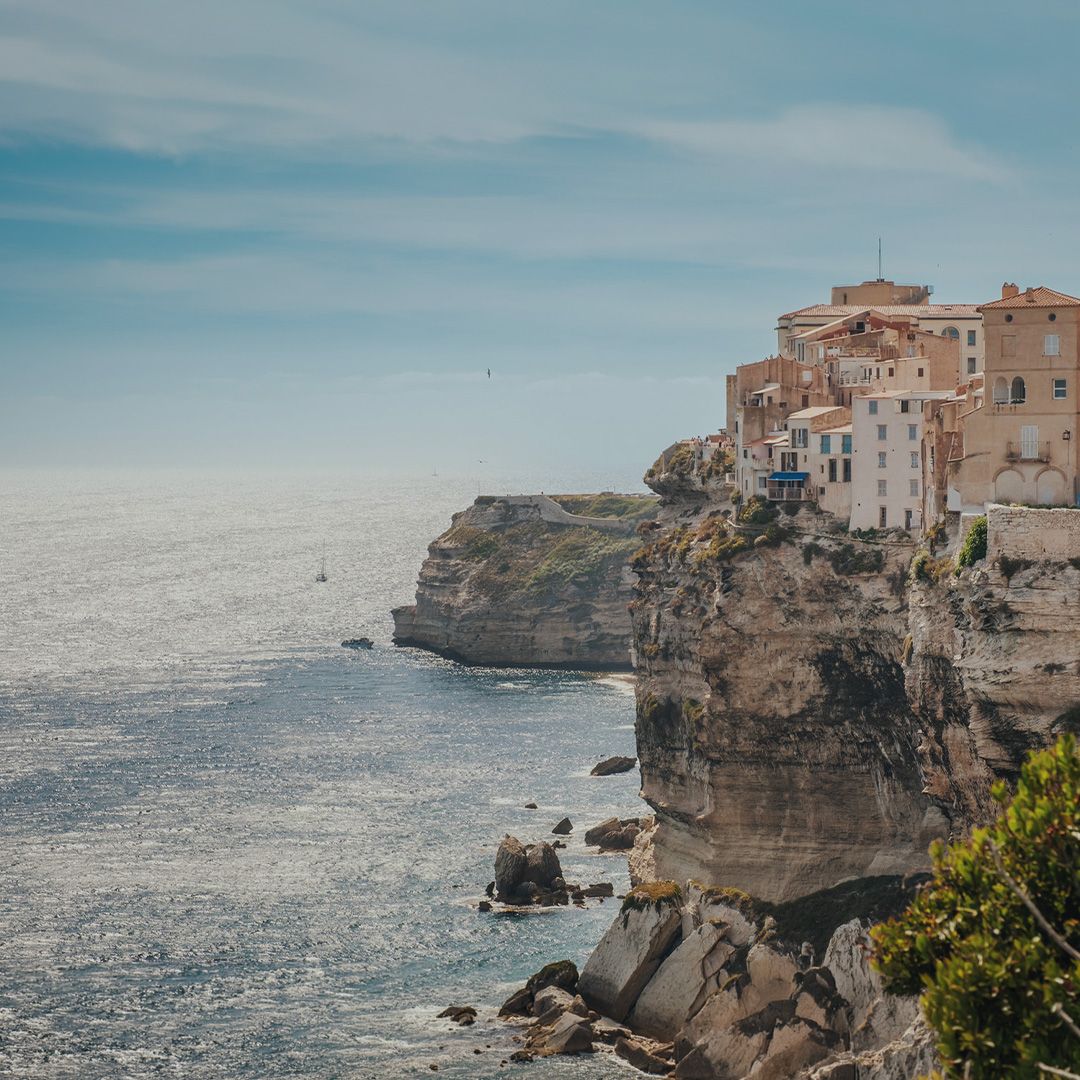
A Corsica yacht charter is the best way to experience this distinctive combination of class and charm, which is influenced by both French and Italian cultures, and which can be found in the cuisine, architecture, and dialect.

Sardinia
Top features


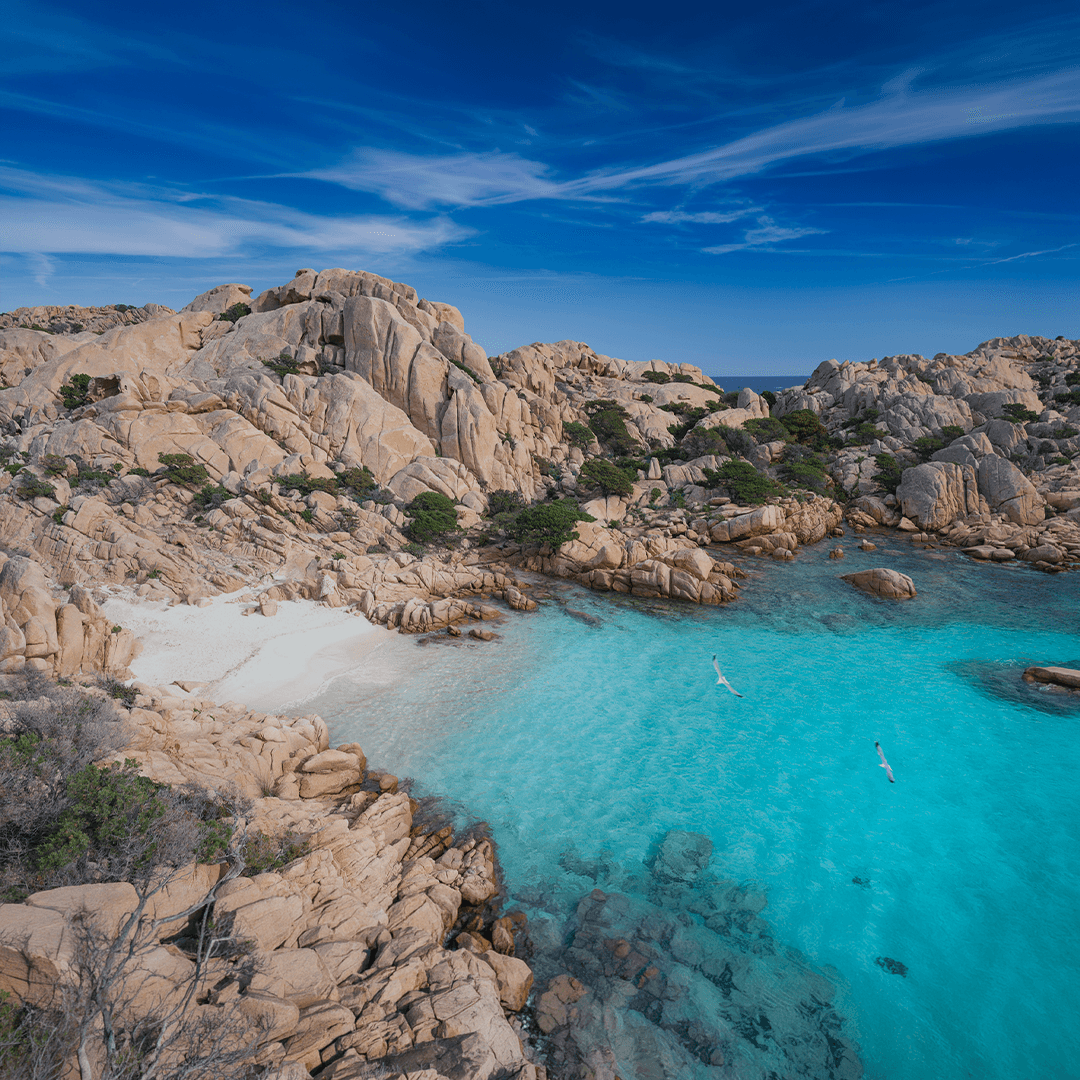
A Sardinia yacht charter is the best way to experience this distinctive combination of class and charm, which is influenced by both French and Italian cultures, and which can be found in the cuisine, architecture, and dialect.

French Riviera Yacht Charters
Top features


The Riviera is a section of coastline between Cannes in France and La Spezia in Italy, offering such mild winters and gloriously hot summers that it’s the perfect spot in the Mediterranean for a vacation spent aboard a glamorous yacht. While the activities and events you can get up to are wide-ranging, it’s wise to do your research and make your selections well ahead of time for shore visits.


Italian Riviera Yacht Charters
Top features
The Riviera is a section of coastline between Cannes in France and La Spezia in Italy, offering such mild winters and gloriously hot summers that it’s the perfect spot in the Mediterranean for a vacation spent aboard a glamorous yacht. While the activities and events you can get up to are wide-ranging, it’s wise to do your research and make your selections well ahead of time for shore visits.

What Our Clients Are Saying
Real reviews from our charter guests worldwide. Read More
291 Reviews